



- Greetings from the president
- Greetings
- Best Paper Awards
- The successful autumn academic conference in the amid of COVID-
- 2019 KSES American Traveling Fellow 연수기
- The 29th Annual International Congress of KSESr
- 의료칼럼: 3D navigation guided reverse shoulder arthroplasty
- 견슬라이더컵 골프대항전 대표선수 선발전 공지
- 학회 지난 소식들
- 회원동정
- 학회 신입회원 명단
2019 KSES American Traveling Fellow Training
Yong Beom Lee
Hallym Univ. Sacred Heart Hospital
They say that a half of the fun of traveling comes from planning and waiting for travel and that the other comes from memorizing and organizing your photo album. At this time when going overseas has become extremely difficult due to COVID 19, I would like to remember the six-week training of KSES Travelling Fellow in the fall of 2019 reminiscing on how happy the old days were and wishing that ordinary time like before will come soon.
I was selected as the 2019 KSES travelling fellow with the help from the president of the Korean Shoulder and Elbow Society, board members and the members of the society in 2018. With excited heart, I left the Incheon Airport with Professor Yeong Min Noh of Donga University and headed to Los Angeles on September 15, 2019.
The first week’s schedule began with visiting Professor Thay Q. Lee who moved his office from UC Irvine to Pasadena, the luxurious streets of LA. I heard a lot about the place, and at the laboratory where many of the members of our society came for training, the experiments about Shoulder Biomechanics were continuously taking place, and I was deeply impressed at him personally producing equipment as well as carrying out experiments. Later, we visited the operating rooms of
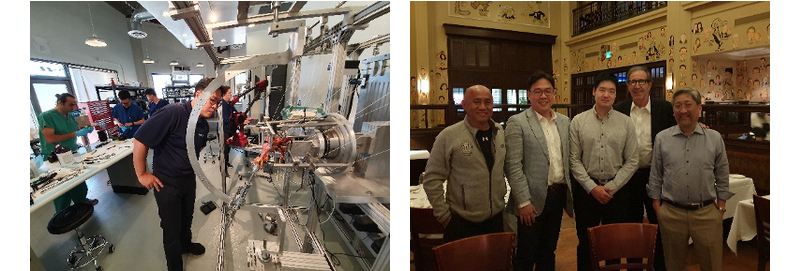
Professors James Tibone and John Itamura at Kerlan Jobe Orthopedic Clinic and at University of Southern California, respectively. I got the impression that this place was really the west at their performing operations with endless jokes in their operating rooms with cheerful atmosphere which was unique to the American West. We also visited Maxwell Park well known as whom invented the Suture Bridge Technique, and since he invited us to his house, we spent a day together. I was deeply impressed with the fact that although he was a successful medical practitioner, he was still devoting one day a week into the cadaver study at the laboratory of Professor Thay Lee of OBL.
On the second week, we visited Steadman Hawkins Clinic in Greenville, South Carolina. We were greeted by Professors Kissenberth and Tolan. Unlike the outer appearance that resembled a serene hospital in the countryside of the south with fine weather, it was a hospital filled with researchers along with all the research facilities that one could think of in the field of orthopedics such as Cadaver labs, Biomechanical labs, Regenerative medicine labs (stem cell) and Ultrasound labs
On the third week, we visited Professors J. P. Warner and Luke S. Oh of Massachusetts General Hospital in Boston. We were able to observe Professor Warner’s RSA revision surgical procedure and the elbow operation by Professor Luke S. Oh and left behind a pleasant memory of presenting at the Harvard Medical Center. Professor Luke Oh treated us with hospitality with that Busan dialect that came out when she was in a hurry and invited us at her place and welcomed us with the Korean food that she made herself.
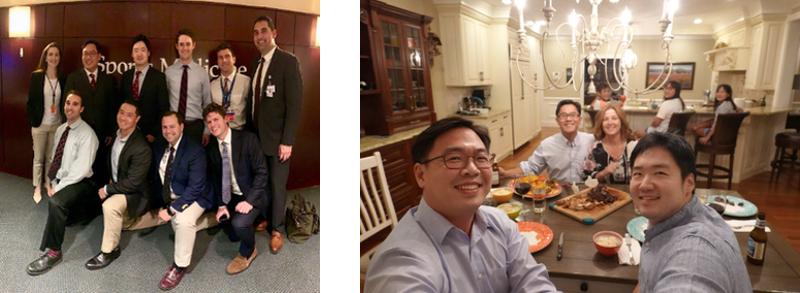
After three days in Boston, we visited Rothman Institute of Philadelphia. The shoulder surgeons who worked there had great self-esteem as Philadelphia was the capital of the United States in the 18th century. I felt envy at the fact that eight shoulder surgeons were having discussions, doing research, and treating patients altogether in one hospital.
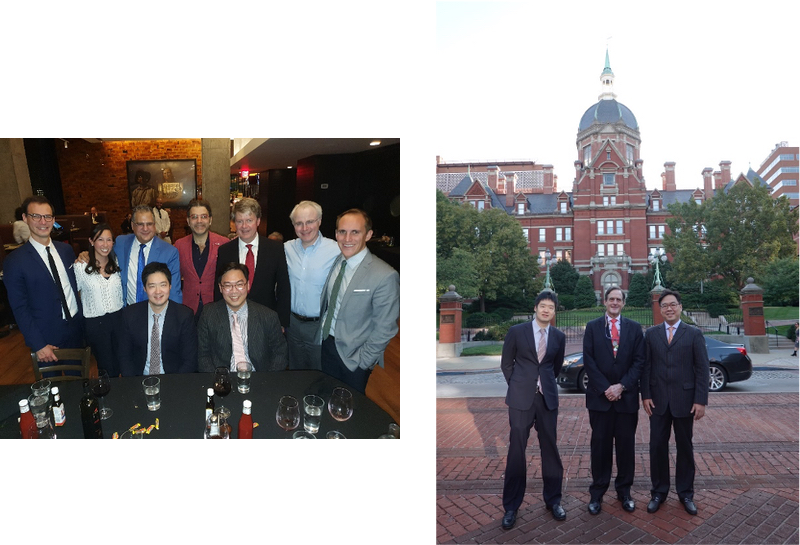
On the fourth week, we visited Mayo Clinic in Rochester and John’s Hopkins hospital in Baltimore. At Mayo Clinic, we watched Professors Shawn O’Driscoll, John Sperling, Joaquin Sanchez, Bassem Elhassan carrying out surgery, and it felt amazing as if it were not real watching all the surgical procedures done in one place by each professor whom I had only met through textbooks and papers. Even though Rochester was a rural village situated at the far north of the United States, a lot of patients had made their way here to have surgical operations and each one’s condition was so bad which made me think that was why they risked coming all this way. Yet, I could not be more amazed at how all the operations were being done on schedule and according to the plan. At John’s Hopkins in Baltimore, Professor Edward McFarland who had visited Korea several times greeted us like a kind old man next door. Looking at him treating his patients with that same kindness and all the patients being satisfied as outpatients, I felt once again that no matter whether in the United States or in Korea, when they treat patients in humane manner, the patients also feel treated humane.
On the fifth week, we visited Professor William Levine of New York Columbia University and participated in ASES Annual Meeting. Professor Levine was a cheerful person and he showed us how enthusiastic he was in every respect including surgery, research, and fellow education. He also was the president of the ASES Society in 2020 and had an extraordinary love for Korea. ASES Annual Meeting is a closed meeting in which only ASES members are allowed to present and participate. I was amazed and pleased at the holiday-like atmosphere of the meeting where all the people that have gathered there were delighted to see each other like reunited families. When presenting papers and having debates, however, all were showing very enthusiastic and serious attitude that it made me think they were professionals. On some surfaces of the walls, a list of names of donations for development of the society was filling the space, and thoughtlessly looking at it I thought at first, they have put up a huge list of names of the companies as the United States is a capitalistic nation but was surprised to know that most of the people listed were individual members. The list of names of the doctors who donate purely for the development of the society from a few hundred dollars to over 50,000 dollars were many times that of supporting companies. I thought to myself it was this power that built up the country.
Finally, on the sixth week, we visited Baylor University in Dallas and we watched Professor Sumant Krishnan’s RSA. I had heard the rumor, but it was amazing to see him doing 8 cases of RSA including revision from incision to skin suture on his own in one day and I also envied the system that supported it smoothly.
I was really pleased at first when I was selected as KSES Travelling Fellow, but I did not know how to be prepared. When I asked the predecessors how I should prepare, they told me they had many difficulties arranging schedule by hospitals, preparing documents, seeking planes, accommodations, and rental cars. But as I started preparing, I received a lot of help from both KSES and ASES as the relationship between them is now on a stable track due to the continued exchange that lasted for many years.
Lastly, as I look back at the six weeks of Travelling Fellow, I want to say that I was deeply impressed at the excellent systems of the hospitals that we visited, and the way that the professors devoted themselves to the education of medical residents and fellows. It was a meaningful time in that we were able to meet in person and talk with the professors who are leaving significant legacy in both the surgical procedure and research in the field of shoulder and elbow. I would like to thank again the American professors for giving us a warm welcome everywhere we went and giving their best regards to several Korean professors. I would also like to express my deepest gratitude to Professor Yeong Min Noh who stayed together with me without a complaint, though it was a tiring journey with tight schedule.