


- Greetings from the president
- Greetings
- Best Paper Awards
- The successful autumn academic conference in the amid of COVID-
- 2019 KSES American Traveling Fellow 연수기
- The 29th Annual International Congress of KSESr
- 의료칼럼: 3D navigation guided reverse shoulder arthroplasty
- 견슬라이더컵 골프대항전 대표선수 선발전 공지
- 학회 지난 소식들
- 회원동정
- 학회 신입회원 명단
Participation in the 2024 KSES – ASES Exchange Travelling Fellowship Program
My name is Mohit Gilotra from the University of Maryland in the United States. My co-fellow is Paul Cagle from Mount Sinai Hospital in New York City. We were recently honored to be the American Shoulder and Elbow Society traveling fellows in Asia. Sandwiched in between our time in Japan and China, we spent two weeks in Korea. A huge and hearty thank you to Drs Jieun Kwon and Myung-Seo Kim from the international committee for all the arrangements during our trip.
Neon Orthopaedic Clinic
We started our first week in Korea with the Sports Medicine legend Dr. Jin-Young Park at the Neon Orthopaedic Clinic. Dr. Park explained his journey from academic medicine to his private clinic and all the Olympic and professional teams he has taken care of along the way. His office has so much professional memorabilia that there is hardly any more room! We spent the morning observing shoulder arthroscopy cases and reviewed the high rate of shoulder stiffness in Koreans. This was followed by a visit the Seoul Sky with breathtaking views of the city. In the evening, we were honored to have dinner at Dr. Park’s house hosted by his wife. After spending 5 weeks in Asia eating out of hotels and restaurants, the meal at Dr. Park’s house was the best of the entire trip. The neighboring views of the Han river at night were an added bonus.
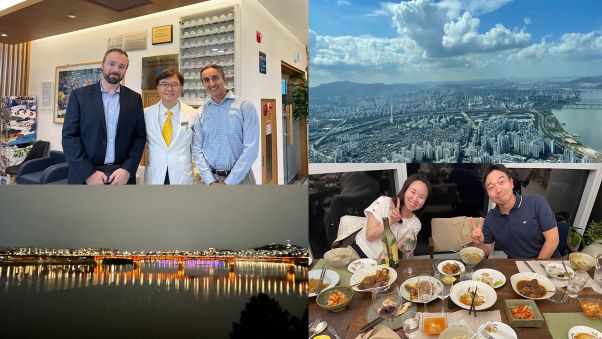
Ewha Woman’s University Seoul Hospital
The next day we visited Ewha Woman’s University Seoul Hospital hosted by Professor Sang-Jin Shin. This day was packed with arthroplasty with Corentec implants and complex arthroplasty. Professor Shin presented some of his research topics in between cases making this one of the highest yield educational days of the entire trip. Particular learning points: strategies to treat anchor pullout, specific cuff repair treatment for crescent, U-shapes and L tears. Tips and tricks for SCR with a 5 cc syringe. The “Shin” lesion in posterior labral tears of weight lifters. I personally have struggled with anterior L tears failing and so Prof Shin explained his augmentation with biceps anterior cable reconstruction.
Seoul National University Bundang Hospital
Professor Joo Han Oh hosted us at SNUH the following day in Seongnam. We started off with research presentations in the morning with Professor Oh’s team and then another packed day of education. We reviewed the history of the nationally renowned ROHI score and the upcoming ROHI scores with subscap included and ROHI-2 without BMD measurements. We observed specific techniques for subascapularis repair using a 70 deg scope in the subsacromial space. In between cases, Prof Oh shared his thoughts on a reverse shoulder tensioning algorithm and tricks to judge rotator interval competency with weighted stress views in internal and external rotation.
Daegu Catholic University Medical Center
To begin our second week in Korea, we embarked on a trip to Daegu to visit the Catholic University Medical Center. The train travel was extremely accommodating, allowing us to enjoy the wonderful scenery of Korea. Upon arriving, we were immediately met at the train station and assisted to the hospital by the team of Professor Chang-Hyuk Choi. This was an especially enjoyable day as it was it was one of our first opportunities to participate in the operating room again. Being surgeons, we were incredibly grateful for the chance to scrub into and observe cutting-edge surgeries. In particular, our day afforded us an opportunity to learn a new and innovative method for shoulder arthroplasty. This technique is something we will both take back with us. Despite only having one day in Daegu, we were still able to have an incredibly wonderful dinner where we tried some of the most unique food of our trip.
St. Mary's Hospital Catholic University
During what was to be our last scheduled day in Korea, we traveled to St. Mary’s Hospital Catholic University. The team of Professor Yang-Soo Kim met us immediately in the morning and preparing us for the day. We were especially intrigued by the opportunity to understand the indications and observe the application of the long head biceps transfer technique. Although arthroscopic tenodesis of the biceps is something we were familiar with, and neither of us had attempted a biceps transfer in the past. Having the unique opportunity to see this performed and understanding the tips and tricks that allow this procedure to go so smoothly gives both of us the confidence to take this procedure back to our own practices and help our own patients. All the staff and support team were incredibly contentious, and we felt exceptionally welcome. We enjoyed a particularly fun meal where we again had very unique food.
Typhoon Krathon vs ACASEA
We thought our trip had ended, and we were both planning to fly to Taiwan for the ACASEA conference. Unfortunately, Typhoon Krathon caused massive flight cancellations and delays. Although we did attempt to reschedule several times, ultimately traveled to Taiwan was not possible. At this point, we did not have any additional scheduled activities in Korea. Without missing a moment, Professor Jae Chul Yoo stepped. Professor Yoo invited us into the operating room with him on the day our flight was canceled, and we were able to observe cutting edge techniques to repair and augment rotator cuff tears. Following this, Professor Yoo arranged a conference where we were able to present our research and hear about the research endeavors of his team. Despite this portion of our trip not having any preset plans, there was never a minute where we weren’t overwhelmingly impressed by the hospitality. Professor Yoo personally took us to several attractions and insured that our remaining time was extremely well spent in Korea. We could not be more grateful for the last-minute accommodations and the incredible effort.
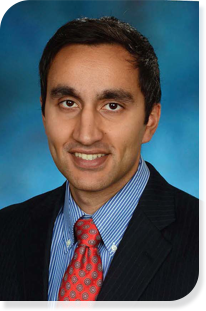 Mohit N. Gilotra, MD
Associate Professor, Department of Orthopaedics
University of Maryland School of Medicine, Baltimore, USA.