



- Greetings from the president
- Greetings
- Best Paper Awards
- The successful autumn academic conference in the amid of COVID-
- 2019 KSES American Traveling Fellow 연수기
- The 29th Annual International Congress of KSESr
- 의료칼럼: 3D navigation guided reverse shoulder arthroplasty
- 견슬라이더컵 골프대항전 대표선수 선발전 공지
- 학회 지난 소식들
- 회원동정
- 학회 신입회원 명단
Participation in the 2026 KSES – JES Exchange Travelling Fellowship program
It is a great pleasure to meet you. My name is Gaku Niitsuma from the Department of Orthopaedic Surgery at Showa Medical University, Tokyo, Japan. I was deeply honored to be selected as the second fellow of the Korean Shoulder and Elbow Society (KSES) – Japan Elbow Society (JES) Travelling Fellowship. This travel marked my first visit to Korea, and it was truly unforgettable experience filled with valuable learning opportunities and warm hospitality. I would like to sincerely express my gratitude to everyone involved in organizing the Travelling Fellowship.
Wonkwang University, Daegu
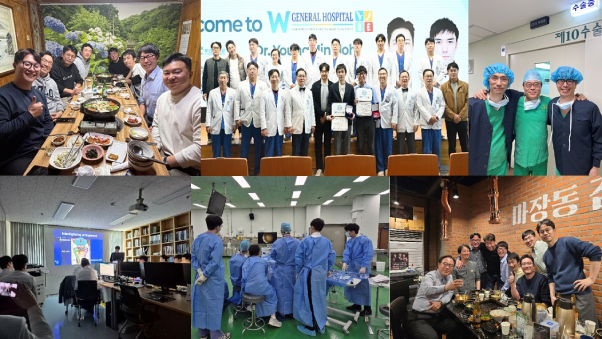
After enjoying the weekend with Dr. Oura in Seoul, we went to Daegu by train. The journey took approximately one and a half hours and was very convenient. Prof. Jeong-Woo Kim and his colleagues kindly welcomed us with a traditional Korean BBQ dinner.
Fortunately, we had the opportunity to observe two cases of total elbow arthroplasty (TEA). The first case was a revision TEA following loosening of the humeral stem of Coonrad-Morrey TEA due to trauma. Prof. Kim performed the revision using a fibular allograft. Through this case, we gained a deeper understanding of component removal techniques and the management of allograft bone using wiring techniques. The second case was a primary TEA for osteoarthritis. Prof. Kim used a lateral para-olecranon approach. He carefully explained the anatomical landmarks used for accurate component insertion, and we also learned valuable cementing techniques.
While observing his surgeries, we were deeply impressed by the precision, efficiency, and sophistication of his surgical techniques. We sincerely appreciate Prof. Kim for preparing these TEA cases for us.
W General Hospital, Daegu
Prof. Jae-Sung Seo, Dr. Young-Woo Kim, and Dr. Don-Ju Shin kindly invited us to an Italian dinner on the evening before visiting hospital.
W General Hospital has 17 operating rooms and a large conference hall capable of hosting international academic meetings. I was astonished to learn that approximately 80 surgeries had been performed in a single day during which surgeons present and discuss the previous day’s surgical cases. Following the case discussions, Dr. Oura and I were invited to the symposium as guest speakers in the impressive conference hall. Prof. Sang-Hyun Woo also introduced us to W Hospital and explained that approximately 2,000 surgeries are performed annually.
In the operation room (OR), we observed 5 cases performed by Dr. Don-Ju Shin. The first case involved implant removal following fixation of a coronal shear fracture of the distal humerus combined with an olecranon fracture. Due to limitations in implant availability in Korea, Dr. Shin had devised a creative method of combining multiple plates for fixation. It was also fascinating to observe his use of a deep flexion technique to visualize the coronal shear fragment from the anterior aspect of the elbow while the patient was in the supine position.
The second case involved a chronic rupture of the radial collateral ligament at the metacarpophalangeal (MP) joint of the thumb. The rupture was located proximally, and Dr. Shin repaired it using a suture anchor technique. The third case was an elbow dislocation treated with an internal joint stabilizer designed by Dr. Shin based on concepts originally taught by Dr. Jorge Orbay.
The fourth case involved an impaction fracture of the capitellum combined with rupture of the lateral collateral ligament (LCL). Dr. Shin performed iliac bone grafting and reconstruction of the LCL.
The fifth case was an elbow dislocation associated with avulsion of the LCL from the distal humerus in a 13-year-old boy. Dr. Shin reconstructed the LCL using two suture anchors.
We are sincerely grateful to Dr. Shin for preparing such a wide variety of fascinating surgical cases for us.
Keimyung University, Daegu
On our final day in Daegu, we visited Keimyung University under the guidance of Prof. Chul-Hyun Cho, who kindly hosted us for Korean BBQ dinner the day before. The following morning, we traveled to the hospital by metro, where Prof. Du-Han Kim welcomed us to the OR. Prof. Kim prepared two clinical cases. The first case involved snapping triceps syndrome combined with cubital tunnel syndrome. Prof. Kim explained that the snapping phenomenon was caused by the medial head of the triceps riding over the medial epicondyle. The patient first underwent anterior transposition of the ulnar nerve, followed by partial excision of the medial triceps muscle. The second case involved elbow joint contracture combined with cubital tunnel syndrome. After anterior transposition of the ulnar nerve, Prof. Kim removed the anterior capsule and anterior osteophytes using the over-the-top approach. Through a medial approach, he additionally removed posterior osteophytes from the olecranon.
Surprisingly, Prof. Kim also prepared cadaveric workshop for us! Each participant was assigned one cadaver specimen, allowing us to practice elbow arthroscopy individually. We performed synovectomy and inserted K-wires into the coronoid tip, simulating fixation of a coronoid fracture. It was an extraordinary and unforgettable experience. After completing the workshop, we traveled to Pohang by train.
Pohang Semyeong Christian Hospital
The first case was total elbow arthroplasty for rheumatoid arthritis. Prof. Rhyou told us the anatomical principles to determine the insertional angle of the components. The second case involved lateral epicondylitis caused by a lateral plica. Prof. Rhyou performed arthroscopic resection of the plica and release of the extensor carpi radialis brevis tendon from the lateral epicondyle.
The third case involved elbow contracture with recurrent ulnar nerve palsy following previous anterior transposition surgery for cubital tunnel syndrome. Prof. Rhyou performed arthroscopic contracture release after open nerve decompression. He explained that he generally considers arthroscopic treatment when elbow flexion contracture is less than 70 degrees.
After completing the surgeries, Prof. Rhyou kindly drove us from Pohang to Busan so that we could attend the KSES president’s dinner.
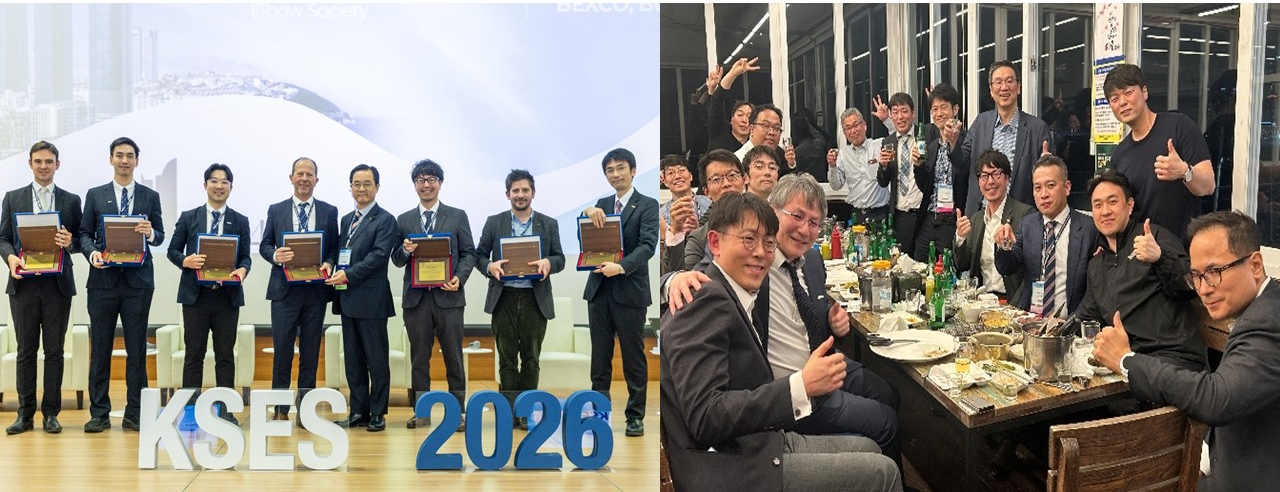
2026 KSES Annual Meeting, BEXCO, Busan
At the president’s dinner, we had the pleasure of dining with many distinguished surgeons from Korea and other countries. It was a wonderful opportunity to reaffirm the strong relationship between members of KSES and JES. Compared with meetings in Japan, we especially felt the highly international atmosphere, as all presentations were conducted entirely in English.
At the congress, I presented a study titled “Parallel vs. Orthogonal Plate Fixation for Complex Distal Humerus Fractures with a Coronal Shear Fragment: A Cadaveric Study,” while Dr. Oura presented “Arthroscopically Assisted Surgery for Pediatric Lateral Humeral Condyle Fractures.”
During the gala dinner, we had another valuable opportunity to interact with many renowned elbow surgeons from around the world. Spending time together afterward at a seafood restaurant by the sea became one of the most memorable moments of our travel. We believe that the second KSES–JES Travelling Fellowship was a great success. We sincerely hope that this valuable relationship will continue to grow and inspire younger surgeons in the future.
We would like to express our deepest gratitude to the international committee chairs of both countries for establishing this travelling fellowship, and especially to the KSES president Prof. Hyun Seok Song for organizing such a wonderful itinerary. This visit to Korea allowed me to build many meaningful friendships. Finally, we hope to continue strengthening the relationship between KSES and JES and to contribute as a bridge between the two societies in the future.
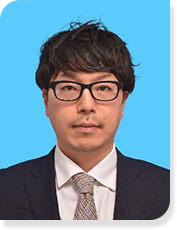 Gaku Niitsuma
Showa Medical University, Tokyo, Japan.