



- Greetings from the president
- Greetings
- Best Paper Awards
- The successful autumn academic conference in the amid of COVID-
- 2019 KSES American Traveling Fellow 연수기
- The 29th Annual International Congress of KSESr
- 의료칼럼: 3D navigation guided reverse shoulder arthroplasty
- 견슬라이더컵 골프대항전 대표선수 선발전 공지
- 학회 지난 소식들
- 회원동정
- 학회 신입회원 명단
Participation in the 2026 TOSSM Travelling Fellowship program
First, I would like to express my deepest gratitude to the Korean Shoulder and Elbow Society (KSES) for the prestigious opportunity to participate in the 2026 Traveling Fellowship. This program provided an invaluable platform for academic exchange and clinical observation across nine world-class medical institutions in South Korea. Throughout the fellowship, I had the privilege of observing over 40 complex shoulder and elbow cases, ranging from advanced arthroscopic repairs to complex open reconstructions. The following report summarizes the key surgical insights, technical innovations, and clinical philosophies encountered during this productive exchange.
Asan Medical Center (Prof. Kyoung-Hwan Koh)
I was deeply impressed to visit Asan Medical Center, which is renowned as the largest hospital in South Korea. During my time there, I observed meticulous soft tissue management and a systematic release for elbow stiffness designed to prevent Heterotopic Ossification. For massive cuff tears, I noted the use of medialization techniques combined with PRP injections. I also observed the application of arthroscopic free bone blocks to address severe glenoid bone loss.
Samsung Medical Center (Prof. Jae-Cheol Yoo)
I had the privilege of learning the classification of Subscapularis tears directly from the original source. Prof. Yoo taught us to identify the "Sentinel Sign" (medial biceps pathology) as a vital indicator for hidden subscapularis lesions. A significant technical insight was his preference for subacromial-view SSc repair, providing a superior perspective of the footprint. The clinic also showcased advanced biological treatments using Dermal allograft, Regeneten and BioBrace. For RSA, I observed the use of CT-based navigation and PSI for precision.
Seoul St. Mary’s Hospital (Prof. Yang-Soo Kim)
I witnessed the application of PSI in an RSA case involving severe glenoid bone loss to enhance baseplate positioning. I also observed the use of BMAC (Bone Marrow Aspirate Concentrate) with Atelocollagen for biological augmentation in partial tears. A particular highlight was watching the Professor’s dedication to explaining surgical outcomes to the patient’s family immediately after the procedure. This immediate post-operative communication was an inspiring practice that I found to be truly excellent.
Myongji Hospital (Prof. Yong-Girl Rhee)
Learning open revision rotator cuff repair was a vital experience for me, as it is a crucial skill for complex cases where arthroscopic methods may not be successful. I observed a masterclass in complex access, specifically utilizing the "3 Sister Portals" and "T-Handle Antegrade Repair" for massive rotator cuff tears. Prof. Rhee taught us how these classic techniques remain a reliable and steadfast option for difficult cases.
VHS Medical Center (Dr. Hee-Dong Lee)
I observed a unique and cost-effective approach to autologous augmentation using the patient's own Palmaris Longus tendon for medium-to-large tears. I also noted an efficient clinical workflow involving a "Dry Scope" technique at the end of procedures to ensure PRP or collagen injections are delivered at maximum concentration.
Neon Orthopedic Clinic (Prof. Jin-Young Park)
Starting the second week, I observed high-level precision maintained within a streamlined clinic setting. I witnessed the "Biceps Rerouting" technique, which utilizes the LHBT as a "biologic bridge" to reinforce supraspinatus repair. I also observed meticulous "Corner Closure" with free absorbable sutures to ensure a truly anatomic restoration of the cuff footprint.
Seoul National University Bundang Hospital (Prof. Joo-Han Oh)
I had the opportunity to present my research and received valuable comments and feedback from the Professor. During the clinical session, I observed a systematic technique for releasing rotator cuff tears in a stepwise manner. Prof. Oh taught us the specific criteria for distal clavicle resection and coracoplasty. I also gained insights into the logic behind various biologic augmentations and witnessed a rare deltoid repair in RSA, which is a precious experience for my future practice.
Seoul National University Hospital (Prof. Sae-Hoon Kim)
The highlight of this visit was the Muscle Advancement technique for irreparable tears. I observed that Suprascapular Nerve (SSN) release is a critical step in this process to prevent nerve tension while advancing the muscle to achieve coverage. I also watched the adjustment of RSA biomechanics specifically tailored for the smaller bone morphology of Asian patients. I am very grateful for the Professor’s kind and attentive care during my visit.
Ewha Womans University Hospital (Prof. Sang-Jin Shin)
I was impressed by the Professor’s dedication to teaching me the principles of rotator cuff treatment, including the mapping of rotator cuff repair, during surgery and even while traveling to the hotel for the KSES meeting. He taught us the "Shape over Size" philosophy, which prioritizes tear patterns and force couple balance over simple tension. I also viewed an ingenious "Syringe Technique" used to organize multiple sutures during graft delivery.
KSES Annual Meeting
I attended the KSES meeting, learning from both Korean and international experts. During the event, I presented my research in both Podium and Poster formats. At the banquet, I had the honor of spending time with the President, Prof. Hyun-Seok Song. He was incredibly generous with his knowledge, sharing his personal techniques for repairing panlabral tears and offering deep insights into the leadership of the society.
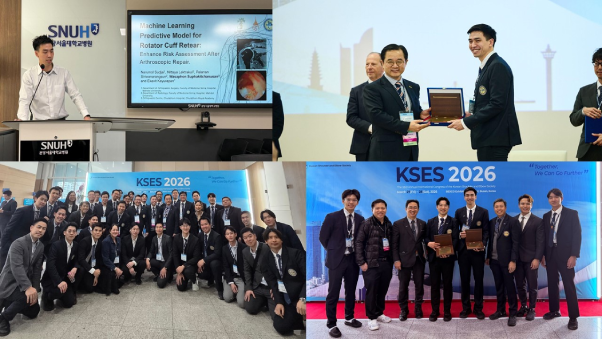
Conclusion
This fellowship has been a transformative experience, offering a profound look into the synergy of surgical speed, technical precision, and the innovative application of biologics that defines South Korean orthopedics. I have gained a wealth of knowledge, from advanced biomechanical concepts in RSA to systematic research methodologies, that I am eager to implement at Chulabhorn Hospital and TOSSM. I am committed to sharing these techniques with my colleagues and students in Thailand to help elevate our local standards of care to an international level.
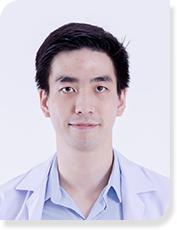 Wasaphon Suphakitchanusan
Chulabhorn Hospital, Thailand